Inside the Machine No. 01
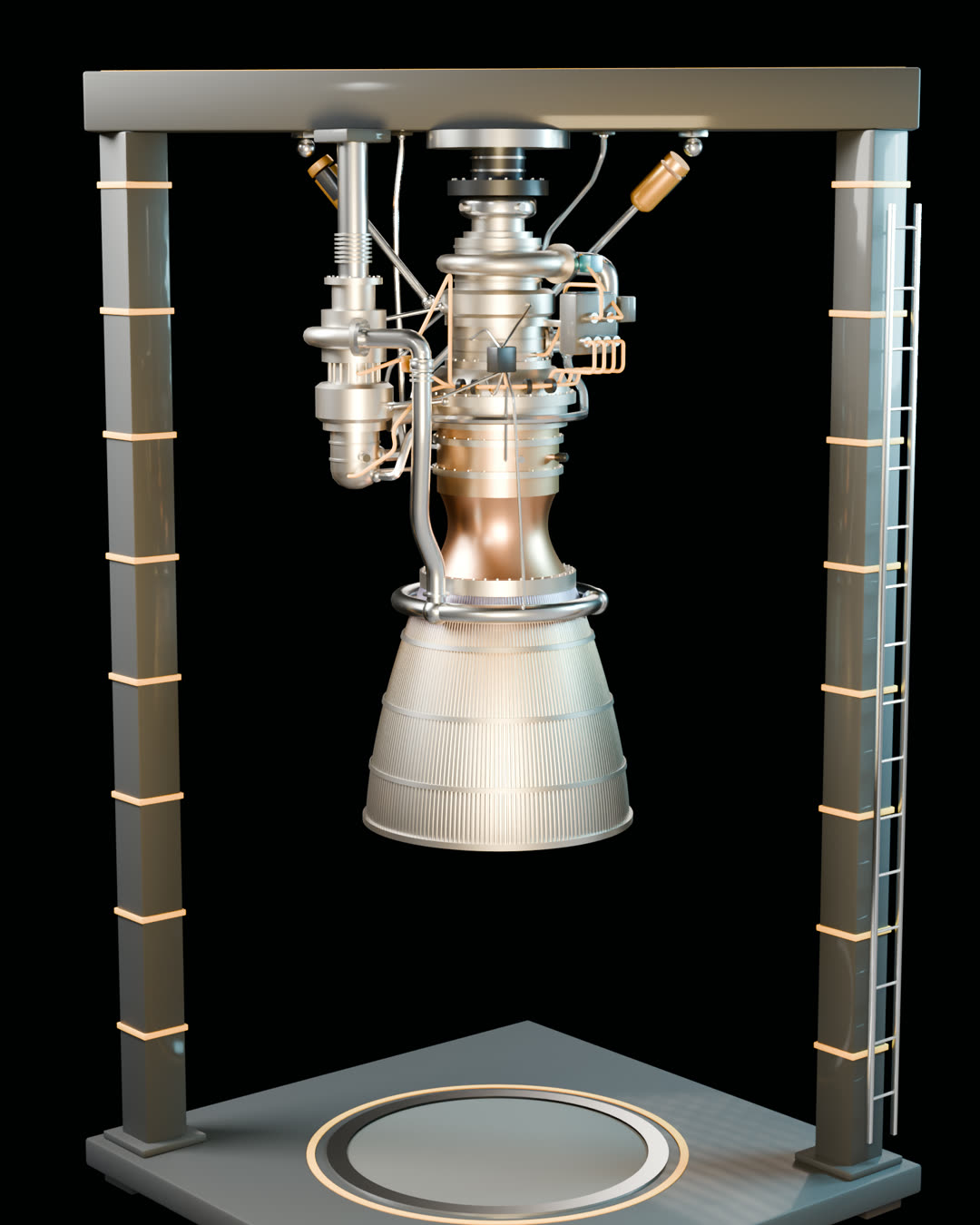
SpaceX Raptor 2
A rocket engine that burns methane and liquid oxygen, pushes with about 230 tonnes of force, and weighs about as much as a car. Scroll to take it apart.
A methane rocket engine with about 230 tonnes of push. Let's take it apart.
02 / Parts
Two pumps, two fires, one chamber
Every part of Raptor exists to do one thing: push a huge flow of propellant into the main chamber at about 300 bar, roughly 300 times the air pressure around you.
Every part feeds one chamber at about 300 bar.
03 / Oxygen side
Oxygen spins its own pump
Liquid oxygen colder than minus 180 °C enters the oxygen turbopump. Then it flows into the oxygen-rich preburner, where a little methane burns in it. That hot, oxygen-rich gas spins the turbine that drives the pump.
Hot, oxygen-rich gas spins the oxygen pump.
03 / Methane side
Methane cools the engine first
Methane leaves its pump, runs down the downcomer and through channels in the nozzle and chamber walls. It soaks up heat that would otherwise melt the metal, then feeds the fuel-rich preburner.
Cold methane runs through the walls so the metal does not melt.
03 / Full flow
All of it burns twice
Full flow means all the oxygen goes through one preburner and all the methane through the other. Each hot gas spins its own turbine, then both meet in the injector and burn again in the main chamber.
Every drop burns twice: in a preburner, then in the chamber.
04 / Pressure
A storm squeezed through a throat
The gases mix at about 3.6 kg of oxygen per kg of methane and burn at roughly 3,500 K. The narrow throat chokes the flow, and the bell turns that pressure into speed.
A narrow throat turns pressure into speed.
- Chamber pressure
- 0bar
- Gas temperature (estimate)
- 0K
- Mixture ratio O : CH₄
- 0.0: 1
05 / Ignition
230 tonnes of push
The exhaust leaves faster than sound and overshoots the outside air pressure, so shock waves bounce inside the plume. Those bright knots are shock diamonds.
The bright knots are shock diamonds.
- Thrust at sea level
- 0tf
06 / The numbers
Raptor 2, in six numbers
- ~230 tfthrust at sea level
- ~300 barmain chamber pressure
- ~1,630 kgengine mass
- 3.6 : 1oxygen to methane, by mass
- ~347 sspecific impulse at sea level
- 2preburners, one per turbopump
Designed and built by Gagan, Senior AI Developer. Science, tech and AI, explained simply.
Sources
- Wikipedia, SpaceX Raptor: cycle, Raptor 2 thrust (230 tf), mass (1,630 kg), 3.1 m by 1.3 m, oxygen-rich and fuel-rich turbines.
- NASASpaceFlight, Musk outlines Starship progress towards self-sustaining Mars city (11 Feb 2022): Raptor 2 redesign, 230 t versus 185 t for Raptor 1.
- Elon Musk on X (3 Jan 2022): "Raptor 2 now operates routinely at 300 bar main chamber pressure."
- Everyday Astronaut, Is SpaceX's Raptor engine the king of rocket engines? (2019) and Raptor 1 vs Raptor 2 (2022): how full-flow staged combustion works; 230 tf.
- FAA, Draft Programmatic Environmental Assessment for SpaceX Starship/Super Heavy at Boca Chica (2021): methane and oxygen burned at a 3.6 to 1 mass ratio.
- SpaceX on X (3 Aug 2024), Raptor performance figures: sea-level specific impulse 347 s.
- Temperature: our estimate for methane and oxygen near this mixture ratio and pressure from standard combustion equilibrium (NASA CEA style); not a published SpaceX figure.
- Part layout: Raptor 2 anatomy illustration by Ryan (wheresryan22), MIT licence. The 3D model is a procedural illustration, not engineering data.
- Lighting: studio_small_09 HDRI by Poly Haven, CC0.
Libraries: three.js, three-gpu-pathtracer, three-mesh-bvh (MIT), GSAP and ScrollTrigger (GSAP standard licence), Lenis (MIT). Fonts: Archivo, Inter Tight, JetBrains Mono (SIL OFL). Not affiliated with SpaceX.